

Why You Wake Up Stiff After Napping on the Sofa: How Sofa Support Affects Rest
Quick answer: Waking up stiff after napping on the sofa usually comes down to poor support, not bad luck. Sagging cushions let your pelvis tilt backwards, armrests twist your neck out of alignment, and sofas simply aren't built for lying down. The fix isn't avoiding naps altogether; it's improving the support beneath you, whether that's firmer cushion foam, proper positioning cushions, or a sofa cushion refilling service.
If you've ever curled up for a "quick 20 minutes" and woken up unable to turn your neck, you're far from alone. It's one of the most common complaints among adults who regularly unwind on the sofa after a long shift or a demanding day, and it's rarely about the nap itself.
It's about what is (or isn't) supporting your body while you sleep.
Sofas are built for sitting upright, not for lying flat.
Once you factor in sagging foam, unsupported necks, and awkward hip angles, it's little wonder that an innocent afternoon doze can leave you feeling like you've done a round in the gym. Below, we'll explore exactly why sofa nap back pain happens, what the research says about couch posture sleep, and most importantly, what you can do to make your sofa naps genuinely restful again.
Why Sofas Aren't Built for Lying Down
A sofa and a mattress might look similar from across the room, but they're engineered for completely different jobs. Mattresses are designed to support your body evenly across several hours of lying flat. Sofas, by contrast, are designed for sitting, which means their cushion depth, backrest angle, and armrest height are all optimised for an upright position, not a horizontal one.
According to Sleep Foundation, mattresses are purposely designed to support spinal alignment and reduce pain and discomfort from pressure points, while medium-firm mattresses in particular have been shown to reduce sleep-related discomfort and lower back pain. Sofas simply don't offer the same engineering.
When you lie down on a sofa, a few predictable things happen:
- Your legs may not fit. Most sofas are shorter than the average bed length, forcing your knees to bend or your feet to dangle off the end.
- Your arms lack a consistent position. Research published in the Journal of Physical Therapy Science found that asymmetrical arm positioning during sleep significantly increases activity in the neck's trapezius and scalene muscles, the muscles responsible for that "crick in the neck" feeling.
- Your neck has nothing reliable to rest on. Armrests and decorative cushions aren't designed to hold the neck in a neutral position, which can lead to stiffness, headaches, or shoulder tension by the time you wake up.
Even side sleeping, generally considered the most comfortable sofa position, comes with a catch: a short sofa can force your knees into a bent position for the full duration of the nap, which may cause joint pressure to build.
"Sleep posture is an important predictor of stiffness, back pain, and neck pain... Couches were designed for relaxing in an upright position, not as a place to sleep." - Healthline
How Sagging Cushions Strain the Neck and Spine
Even if you find the perfect lying position, a well-used sofa can undo all your good work.
Cushion filling naturally compresses and loses its shape over time, particularly if the sofa sees daily use. According to our very own guidance on sofa cushion firmness, when you sit or lie on a degraded cushion, your spine falls out of its natural alignment, forcing your lower back muscles to work overtime.
This matters just as much for napping as it does for sitting. Here's the mechanical chain reaction that unfolds on a sagging sofa:
|
Cushion Condition |
Effect on Body |
Likely Result |
|---|---|---|
|
Firm, high-density foam (28-32 kg/m³) |
Hips stay level with or above knees |
Neutral spine, less strain |
|
Worn, sagging foam |
Pelvis sinks, knees rise above hips |
Pelvis tilts back, lumbar pressure increases |
|
Uneven or lumpy filling |
Body tilts or rotates unevenly |
Asymmetrical loading on one side of the spine |
Chiropractors back this up and note that couches commonly create three predictable spinal problems during sleep: poor lumbar support as the low back sinks or twists, inadequate neck support from armrests and cushions, and asymmetrical positioning that loads one side of the spine more than the other for hours at a time.
Even if you felt perfectly comfortable when you dozed off, prolonged static positioning on uneven support can lead to joint stiffness and muscle guarding by the time you wake.
Physical therapy expert Dr. Amy Konvalin (PT, PhD) explains in her analysis on sofa-induced back pain [03:53] that this loss of alignment triggers a specific muscular breakdown. The deep, static stabilising muscles designed to keep your spine aligned become exhausted under awkward loads.
When those primary stabilisers give up, the dynamic lumbar paraspinal muscles, the thick bands running along either side of your spine, are forced to take over:
"Those ropes (paraspinal muscles) will get really tight if they're having to control the motion for a prolonged period of time... when those passive muscles get tired, those active muscles come in and start helping maintain that postural tone, and they fatigue very quickly." - Dr. Amy Konvalin, PT, PhD
This creates a state of muscular guarding. As the paraspinals fatigue and spasm to protect your spine from further torque, blood flow to the tissue decreases. When you stand up after your nap, these overworked muscles refuse to lengthen immediately, resulting in that telltale bent-over shuffle across the living room rug.
The good news is that this is one of the easiest problems to fix.
Rather than replacing an entire sofa, a costly and environmentally wasteful move, given that UK furniture waste reaches an estimated 670,000 tonnes annually, a sofa cushion refilling service can restore the supportive structure your body needs, using high-density foam that holds its shape and bounces back the moment you stand up.
Why Even Short Sofa Naps Leave You Aching
It's a common myth that only all-night sofa sleeping causes problems, and that a 20-minute power nap is somehow exempt.
Unfortunately, duration matters less than you'd think; it's really about how static your position is.
Urban Sports & Rehab Centre's physiotherapy team explains this well: a position that feels comfortable for 20 minutes may not feel comfortable after several hours, but even shorter naps in a poor position can trigger temporary stiffness if your neck, hips, or spine are left unsupported throughout.
The issue isn't necessarily the position itself; it's the combination of poor cushion support, an unsupported neck, and a complete lack of movement while your muscles and joints sit static.
This explains why you might nap for only half an hour and still wake up feeling like you've slept folded in half. A few key culprits:
- Pelvis sliding forward on a deep cushion, rounding the lower back
- Hips flexed deeply, with knees sitting higher than hips
- Neck resting against an armrest or shoulder, rotated or tilted for the duration of the nap
- Uneven cushion support, causing the body to twist or tilt without you realising
None of this means you have a slipped disc or a serious spinal issue; most sofa nap back pain is mechanical and resolves within a day or two once normal movement resumes. But if it's a regular occurrence, it's worth asking whether your sofa itself is contributing to the problem.
See also - The Nap Blueprint: How to Recharge Without Ruining Your Night’s Sleep

Firmer Support for Comfortable, Ache-Free Naps
The reassuring part of all this research is that sofa nap back pain is largely preventable. You don't need to give up your favourite napping spot; you need to improve what's supporting your body while you're there.
Start with the cushions themselves
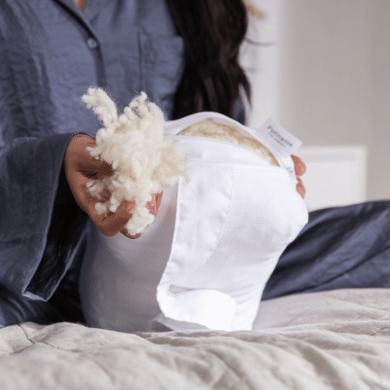
If your sofa cushions have lost their bounce, no amount of careful positioning will fully compensate. Our sofa cushion refilling service replaces tired, flattened interiors with high-density polyurethane foam (typically 28-32 kg/m³), available in soft, medium, and firm options depending on your needs. The process is refreshingly simple: you measure your existing covers, we collect them, refill them with premium foam, and courier them back ready to use, a far more sustainable option than buying an entirely new sofa.
Support your neck properly
Rather than relying on a decorative throw cushion, a dedicated neck support pillow such as the Butterfly Pillow, a Japanese-style multi-use cushion designed for neck and sleep support, can keep your head in a neutral position instead of twisted against an armrest.
Add targeted lumbar support
For anyone who naps semi-upright or watches TV before dozing off, a lumbar support cushion from our backcare range can be positioned in the small of your back to maintain a neutral spine and prevent the pelvis from sliding forward into that rounded, strained position.
Elevate properly if needed
If you tend to nap propped up (common for those managing reflux or congestion), a proper bed wedge offers a consistent, supportive incline far more reliable than stacking standard cushions, which shift and flatten as you sleep.
Keep your knees supported
If you're lying on your back, placing a small pillow under your knees, as recommended by sleep health experts, helps keep the pelvis level and reduces pressure on the lower back.
See also - The Micro-Nap: Can 10 Minutes Really Change Your Day?
Rest That Doesn't Cost You the Next Day
A sofa nap should leave you feeling refreshed, not reaching for the paracetamol.
Most sofa nap back pain comes down to a few fixable mechanical issues: sagging cushions that let your spine fall out of alignment, unsupported necks twisted against armrests, and hips sitting higher than they should.
The fix doesn't require sacrificing your favourite spot on the sofa. Refilling tired cushions with high-density foam, adding proper neck and lumbar support, and being a little more intentional about how you position yourself can transform your sofa from a stiffness trap into a genuinely restful retreat.
If your cushions have seen better days, it's worth exploring our sofa cushion refilling service, a simple, sustainable way to bring reliable, ache-free comfort back to your everyday napping spot.
“Let’s begin by taking a smallish nap or two.” - A.A. Milne
Frequently Asked Questions
Why do I wake up stiff after a nap on the sofa?
Stiffness after a sofa nap is typically caused by a combination of sagging cushion support, an unsupported neck resting against an armrest, and a static position held for an extended period.
Even short naps can cause temporary stiffness if your spine and neck aren't properly aligned.
Is sleeping on the sofa bad for your back?
Occasional sofa napping is unlikely to cause lasting harm. However, regularly sleeping on a sofa with poor cushion support can contribute to ongoing back and neck discomfort, particularly if the sofa allows your pelvis to sink or your spine to twist.
How can I make sofa naps more comfortable?
Focus on improving support rather than avoiding naps altogether. Refill sagging cushions with high-density foam, use a dedicated neck support pillow instead of a decorative throw cushion, and consider a lumbar cushion if you tend to nap semi-upright.
How often should sofa cushions be refilled?
There's no fixed timeline, as it depends on usage, but if your cushions feel soft, saggy, or require daily plumping to hold their shape, it's a sign the interior foam has broken down, and refilling is worth considering.
Is a firmer sofa always better for napping?
Not necessarily. The goal is consistent, supportive comfort rather than maximum firmness. A very soft sofa allows your body to sink too deeply, while an overly firm surface can create uncomfortable pressure points. High-density foam strikes the right balance for most people.


From the blog
View all




Leave a comment