

Why You Sleep Worse in an Unfamiliar Bed: The Science of the "First Night Effect"
Quick Answer: The first night effect sleep phenomenon happens because one half of your brain stays partly on guard in unfamiliar surroundings, delaying sleep onset and fragmenting rest. Unfamiliar mattress firmness and pillow height make it worse. Recreating familiar support, like your own travel pillow, can help your body settle faster, wherever you're sleeping.
You've booked a lovely hotel room. The sheets are crisp, the pillows are plumped, and yet you lie there wide awake, wondering why your own bed never does this to you. If you've ever asked yourself why can't I sleep in a new bed, you're not imagining things, and you're certainly not alone.
Sleep scientists have a name for this: the first night effect.
Understanding what is the first night effect can help you stop fighting your biology and start working with it. The short version: your brain treats new environments with a degree of caution it simply doesn't apply at home. Add an unfamiliar mattress or the wrong pillow height into the mix, and a single disrupted night can turn into a pattern of sleeping badly in unfamiliar bed situations every time you travel, stay with family, or move house.
Why Does Half Your Brain Stay on Alert in a New Place?
In 2016, researchers at Brown University, led by Masako Tamaki, made a striking discovery. During the first night participants spent sleeping in an unfamiliar laboratory setting, the left hemisphere of the brain showed less deep, slow-wave sleep activity than the right. The left side also reacted more strongly to unusual sounds, producing faster awakenings. By the second night, this asymmetry had largely disappeared (Tamaki et al., 2016, Current Biology). It's worth noting the original study involved a small sample of young, healthy adults, so researchers have continued investigating the effect since.
A later re-analysis published in Sleep (Wick, Combertaldi & Rasch, 2024) confirmed that this effect can reoccur even across non-consecutive nights, in both unfamiliar labs and familiar home settings, particularly affecting sleep onset latency, time spent awake after falling asleep, and total sleep time.
This is widely interpreted as an evolutionary carry-over.
Researchers believe the sleeping brain never quite got the memo that a hotel room is safe. As one sleep scientist put it to the Associated Press, "it doesn't matter if it's a Marriott hotel or it's the savannah... your brain hasn't gotten the memo that this place is completely safe." That's the evolutionary logic behind why do I sleep worse in a new place: your nervous system is still running protective software written for a far more dangerous world.
What Does This Actually Cost You?
- Longer sleep onset: on average, people take around 30 minutes longer to fall asleep in an unfamiliar environment.
- More awakenings: increased wake time after initially falling asleep.
- Shorter total sleep time: less time asleep overall compared to subsequent nights.
- Age matters: the effect tends to be milder in people in their twenties and more pronounced in children and older adults.
This is new bed insomnia in its purest form, not a disorder, but a temporary, biologically driven adjustment period.
How Do Unfamiliar Firmness and Pillow Height Disrupt Sleep?
Brain vigilance is only part of the story. Physical discomfort compounds the first night effect sleep response by giving your nervous system something concrete to react to.
|
Factor |
At Home (Familiar) |
Away From Home (Unfamiliar) |
|---|---|---|
|
Mattress firmness |
Matched to your preference over time |
Often unpredictably soft or firm |
|
Pillow height |
Supports your natural neck curve |
Frequently oversized, flat, or inconsistent |
|
Bedding feel/scent |
Familiar and reassuring |
New textures and smells |
|
Sleep posture support |
Established and stable |
Disrupted, leading to tossing and turning |
Research into bedding supports this link between comfort and sleep quality: a trial published in the Journal of Chiropractic Medicine (Jacobson et al., 2006) found that medium-firm bedding improved perceived back pain, stiffness, and sleep quality compared with older or less supportive setups. Separately, physiotherapists note that pillow height and material affect whether your neck maintains its natural curve through the night, with memory foam, latex, and natural fillings generally offering more consistent support than flattened feather or polyester alternatives.
When your pillow is too high or too low, your neck muscles work overtime to compensate, sending a steady stream of discomfort signals to a brain that is already somewhat on edge. It's a difficult combination: an evolutionary tendency towards vigilance, plus genuine physical strain.
A great support pillow for my neck. Removable cover makes it easy to clean and it’s small enough to travel with. - AS
How Can You Recreate Familiar Support to Sleep Better in an Unfamiliar Bed?
You can't switch off millions of years of evolution overnight, but you can remove some of the physical triggers that keep your brain alert. The goal of how to sleep better in an unfamiliar bed comes down to a simple principle: give your body and brain familiar, consistent cues wherever you are.
This is where a travel pillow's familiar support becomes genuinely useful, not as a cure for the first-night effect, but as a practical way to reduce one of its biggest aggravating factors.
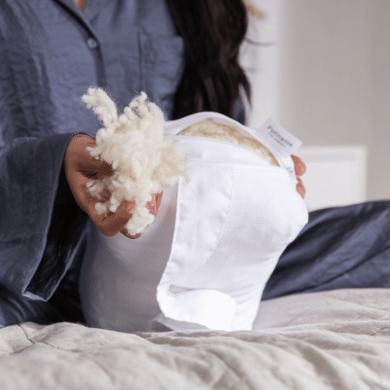
- Bring your own pillow or a compact alternative. The Putnams Butterfly Pillow is a Japanese-style multi-use travel pillow, compact enough for planes, trains, and cars, and available in soft fibre, medium organic British wool, or firm organic buckwheat fillings depending on your preference.
- Use it for more than your head. The Butterfly Pillow doubles as a cervical roll inside a pillowcase, lumbar support, or a knee spacer for side sleepers, helping keep your spine aligned even on an unfamiliar mattress.
- If you're settling into a new home or a regular guest room, the Natural British Wool Mattress Topper adds a familiar, breathable layer of comfort over an unfamiliar mattress. It's a bedroom addition rather than a carry-on item, so it suits a second home or long-term guest space better than a weekend trip.
- For adjustable support, the Organic Buckwheat Hull Pillow can be shaped and adjusted to suit your preferred height, which matters when every bed you encounter is slightly different.
|
Situation |
Suggested Putnams Option |
|---|---|
|
Frequent flights, trains, or car journeys |
Butterfly Pillow (fibre or buckwheat) |
|
Hotel stays, work trips |
Butterfly Pillow (British wool for medium support) |
|
Moving into a new home |
|
|
Staying with family regularly |
It's worth being honest here: no pillow has been clinically proven to eliminate the first-night effect itself, because the effect originates in the brain's response to novelty, not solely in physical comfort.
What familiar support does is remove one layer of disruption, so you're not fighting discomfort on top of natural vigilance. Combined, the evolutionary adjustment and the physical mismatch is sometimes exactly what tips a night from "slightly restless" into genuinely hotel bed sleep quality disappointment.
See also - Why Your Body Aches After a Long Flight or Road Trip: Recovering From Travel Stiffness
Simple Habits That Support Hotel Bed Sleep Quality
Alongside familiar bedding, a few small routines can help:
- Stick to your usual bedtime rituals, even away from home, reading, stretching, or a familiar wind-down sequence all signal safety to the brain.
- Spend a little extra time sitting or reading in the new bed before trying to sleep, rather than getting in and expecting sleep immediately.
- Control what you can: block excess light, dampen unpredictable noise, and keep the room cool.
- Avoid relying on alcohol to fall asleep faster, as it tends to fragment sleep later in the night.
- If you travel often for important events, arriving a day early gives your brain one adaptation night before it matters most.
See also - Does White Noise Help You Sleep? Exploring the Evidence Behind Sleep Sounds
Frequently Asked Questions
What is the first night effect?
The first night effect is a well-documented pattern where sleep quality is measurably reduced during the first night in an unfamiliar environment, typically involving longer sleep onset, more night-time awakenings, and reduced total sleep time, before improving on subsequent nights.
Why can't I sleep in a new bed?
A combination of factors is usually at play: your brain remains partly vigilant in unfamiliar surroundings (the first-night effect), and unfamiliar mattress firmness or pillow height adds physical discomfort on top of that natural alertness.
How long does the first night effect typically last?
For most people, the effect is most noticeable on the very first night and eases by the second or third night as the brain and body adjust. Some research suggests mild effects can persist slightly longer in certain individuals.
Does bringing my own pillow actually help?
It won't eliminate the biological root of the first-night effect, but a familiar pillow can reduce the physical discomfort that often compounds it, supporting your neck and spine in the way you're used to, wherever you're sleeping.
Is new bed insomnia the same as chronic insomnia?
No. New bed insomnia is typically temporary and tied to environmental unfamiliarity. If poor sleep persists regardless of location, it's worth discussing with a healthcare professional rather than attributing it solely to a new environment.
Sleeping Well, Wherever You Are
Sleeping badly in unfamiliar bed situations isn't a personal failing; it's your brain doing exactly what evolution designed it to do. Understanding the first night effect won't make it disappear entirely, but it does mean you can stop blaming yourself for a rough first night away and instead focus on what actually helps: familiar routines, sensible sleep hygiene, and genuinely supportive bedding.
Handmade in Devon since 1979, Putnams has spent decades helping people carry a little more comfort with them, whether that's a Butterfly Pillow for your next trip or a British Wool Mattress Topper for a new home. Explore our full pillows collection and find the familiar support that travels with you.


From the blog
View all




Leave a comment